
Where to begin
And where (and when) to end
Where to begin? The beginning of a story can start anywhere on a chronological line, but because time is becoming much more cosmic as I age, I’ll jump in with what might be the most newsworthy event in my life since we last met here.
I lost my job. Or, rather, it was taken from me. Not stolen, exactly; I was laid off — or, rather, as a freelancer, my contract was terminated. This was not a surprise, but after a 20-year association with The Washington Post, it still stung a bit to read the terse and cold email announcing that the cord had been cut from the other end, with immediate effect, the day before my next scheduled shift. Poof.
I’d had half a foot out the door for a while, for a lot of reasons, and the vibe in the corner of the paper where I had worked part-time for the past 13+ years had been grim all year, and it got a lot darker over the summer. Most of my copy-editing colleagues on the op-ed desk and I, plus a few other folks, were let go — more than a dozen of us, from what I could glean.
The language around having an employer disemploy you is so interesting. To be fired implies you did something wrong and deserved it; plus, it has a shade of violence in it — like, fired as if out of a cannon? Set ablaze, torched? To be laid off suggests hope for a return, as if it’s just temporary, in the way I used to be able to layaway clothes at T.J. Maxx and pay for them in installments until freeing them to take home. To be let go, ah, that suggests a gentle release — We don’t need you anymore, it’s not your fault, good luck. And to lose a job has many associations, as if you let it slip through your fingers or somehow couldn’t keep it. It also implies grief, as all loss does, and that’s not a far slide to being terminated, which is a very deathly word.
Have you ever been disemployed? How did it feel, and what did you do?
I’m fortunate that this was my first layoff, and I’m grateful that this isn’t the end of the world. I had not been depending on the income to pay a mortgage, for example, and if I want to, I can look for other editing work. I feel for my younger and full-time co-workers, some of whom had been with the company for less than a year. I won’t get into the factors I think are undermining The Post, but it appears that even this storied institution is not immune to the larger cultural and political currents swirling in the world at the moment and, especially, in the U.S.
If you like inside baseball, former Postie and Pulitzer winner Gene Weingarten wrote a clever tribute of sorts to us copy editors, upon learning of our bone-headed dismissal, which you can read below — don’t give up; read all the way through (and it’s not clear that “all” of us were fired, but close):

Folks have asked me how it feels to be retired, a word that hits me like an electric shock. Retired from what? I didn’t have a traditional “career” on any particular ladder, so I don’t feel as if I’m stepping off an employment cliff into a clearly defined next chapter. (I still haven’t figured out what color my parachute is.) I turned 58 on Sept. 13, but so what?
Matthew and I are in the middle of a protracted but very welcome move from Clayton, N.C., and a house we’ve lived in for 10 years to a condo at the beach, where I see several opportunities for new roots to be cultivated — in a writing group and the local arts council, with a yoga teacher I admire and through volunteer opportunities with organizations doing work I care about. We’ve spent much time there over our 32 years together, so the soil (or sand) is already fertile and tilled, in a way.
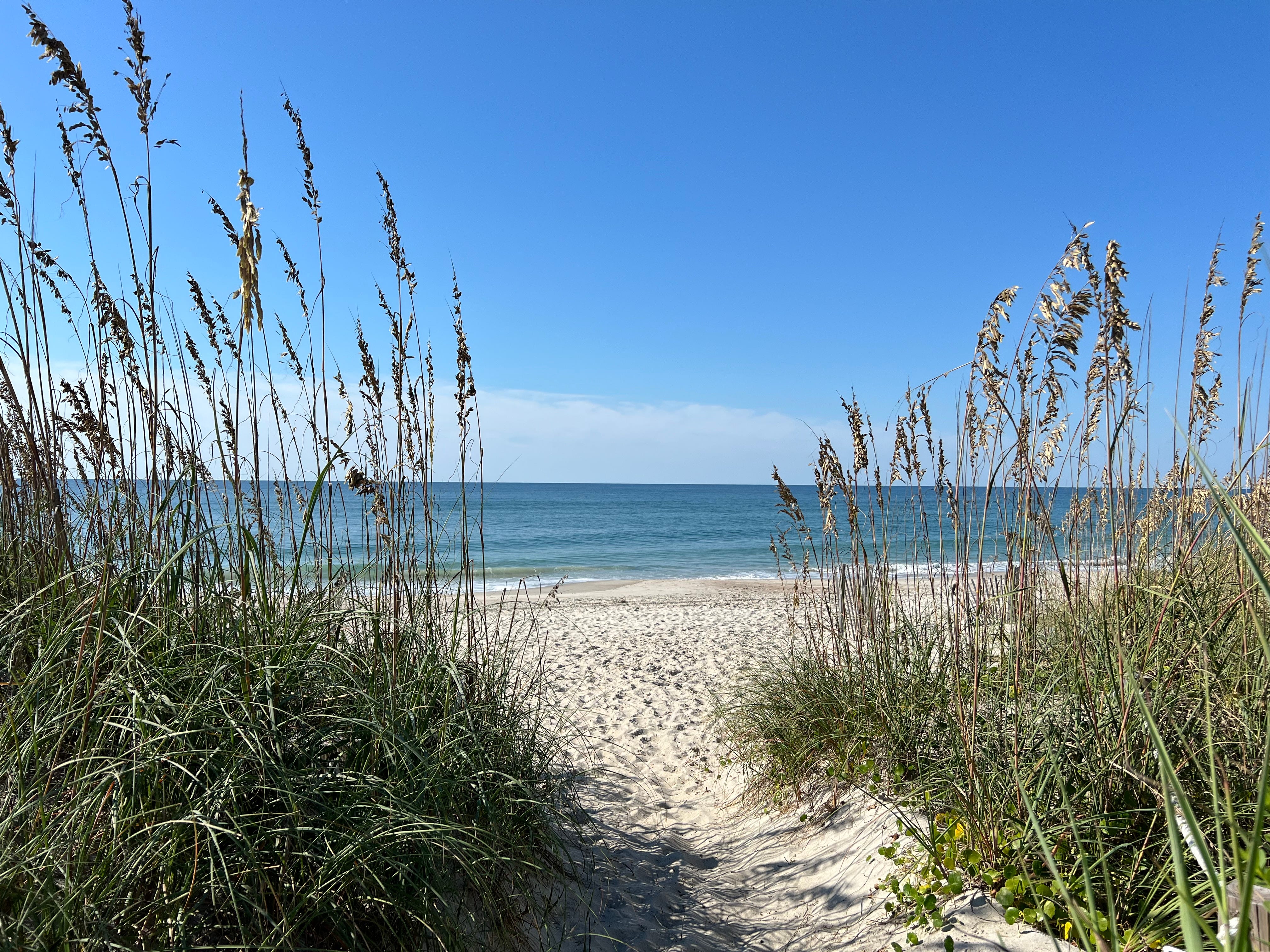
All that, or whatever unfolds, when the moving dust settles, I hope. In the meantime, I continue to see chapters of my life flash before my eyes as I sort through decades’ worth of accumulated stuff in the fairly agonizing yet purifying process of downsizing.
And in divinely timely fashion, I took a break from that seemingly endless work to attend a two-hour Zoom poetry workshop with Ellen Rowland on Oct. 11, in which we studied three poems in tribute to the Earth. “Praise Song” by Elaine Handley begins:
We are tattered bits of cloth
looking for pattern
in the dependable void.
Yikes, right? What an opening. And “dependable void,” oof. The poem goes on to use the imagery of quilting to hold the both-and of joy and horror and to offer readers a choice in how to view the world and our work in it. The narrator asks:
Who is to say what is more useful
or what feeds us best?
The day after the poetry session, I was fed by a daylong retreat hosted by the dynamo that is Betsy Bertram, the aforementioned yoga teacher, at the Hillsborough, N.C., studio of multidimensional artist Sudie Rakusin. Matthew and I got married in Hillsborough, and we moved there a few months after our wedding to be closer to UNC-Chapel Hill for my master’s program, so it was nice to touch this time-warp thread of connection.
On Sudie’s lovely property, nearly 20 of us were treated to a labyrinth walk, stretchy yoga, meditation and pranayama, delicious snacks and tea, nourishing conversations, Ayurvedic tips for navigating seasonal changes and qualities particular to autumn, and Sudie’s mind- and heart-expanding artwork. In the spirit of Ayurveda, which forgivingly teaches the power of remembering and returning to helpful practices, I was reminded again of the blessings of community. Another reason to look forward to those new beach roots.
My intention for the retreat was to look at how to balance flowing with grounding — movement with stillness, diving into the past and looking to the future while dealing with the here and now, which is all we can ever really do. Change might be a constant, but control is often an illusion. As the end of “Praise Song” says:
We have tools: eyes to watch, hands
to soothe, our minds to fasten to
breath, our breath to words, to curse,
to praise our ragged world.
What are your tools? What do you curse and praise, and how do you hold room for the both-and?
Having been liberated from my job, I won’t miss having to read deeply about the soul-destroying and unfathomable crimes against humanity being committed by people inexplicably in power, and I’ll take more breaks from scrolling my news apps, since that kind of homework is no longer required. I support the people still doing the work of true journalism and won’t bury my head from the world in sand completely, but I’m open to exploring the space created by the new vacancy in my schedule.
Two days after receiving the kick-in-the-pants email from a department head I’d never met, I attended my 40th high school reunion. Combined with the sorting-and-purging archaeological dig going on in our house, this was trippy timing. I went to the 30th reunion, my first, and recognized some folks from that one at this one, but otherwise it was like meeting some classmates all over again, or meeting a few I hadn’t really interacted with back then anyway. At one point, four of us from my elementary school gathered away from the main crowd and reminisced, asking about other classmates (some of them dead, one with a long arrest record), the rural valley we grew up in and our current lives.
Meanwhile, a few weeks before that gathering, I had waded through relics from my educational path: Spelling bee lists from elementary school with my mom’s handwriting on the mimeographed pages, my No. 1 coach having added extra words worth knowing, plus certificates and trophies from successful outings, and newspaper clippings with me pictured among other winners. Reports and research papers, including one well-received project in college and my thesis from journalism school. In retrospect, it’s clear where the copy-editing seeds had been planted.
As Danish philosopher Søren Kierkegaard said:
It is really true what philosophy tells us, that life must be understood backwards. But with this, one forgets the second proposition, that it must be lived forwards.
Jack Maden expands on this idea on his Philosophy Break website:
We are constantly moving forward in time. At no point do we get breathing space to pause and understand reality; it continuously unfolds before us. The present is a constant stream of becoming that, when we try to hold it in place with our clumsy descriptions, ideas, and concepts, slips through our fingers. We are thus fated to forever live our lives, Kierkegaard tells us, with incomplete information and understanding. No matter what we want to happen, we cannot ever know what will happen, nor hope to immediately grasp it when it does. Our future lives may split into various possibilities in our imaginations, but we can only ever live one of them — and even the one we ‘choose’ is unlikely to go as planned.
As a copy editor, I spent a lot of time trying to pin down reality and hard facts, lassoing and funneling information, often under stress and with frustration — but also often with satisfaction and a sense of being part of an important big picture. But the older I get and the more I learn, and unlearn, the more I realize that knowledge has its limits, and truth is positional and malleable (sometimes way too malleable).
Fortunately, spiritual practices such as yoga, meditation and pranayama absolutely do give us breathing space (literally) and room in which to pause and reflect. A man at Betsy’s retreat affirmed the value of transitional times and being able to sit in between the past and future. Where else can we be? We can’t stop time, but we can befriend it.
For writers, historians and others, this can be tricky, however, and anyone trying to heal from difficult childhoods or traumas incurred at any point along life’s straight trajectory must do some time-traveling to metabolize wounds and integrate any learned lessons. For me, poetry is a huge meaning-making tool that has helped me do this for decades, the seeds of it having been planted in high school.
While sorting through a box of my first-grade papers my mom had kept — handwriting exercises with the teacher’s corrections in red ink (as I would later make my Post proofing notes), stick drawings with crosshatched crayon marks (I still suck at drawing and painting) — I listened to an interview with former U.S. poet laureate Ada Limón on the “Fresh Air” podcast. While I was looking at the handwriting of my 6-year-old self, and wondering how she learned what was being taught, Limón spoke about how Elizabeth Bishop’s “One Art” seeded a love of poetry in her in high school. The poem is a villanelle, which has a particular structure with repetition and rhyme. Starting with describing the opening stanza, Limón says (bold emphasis mine):
And I remember that phrasing, the art of losing isn’t hard to master. So many things seem filled with their intent to be lost, that their loss is no disaster. And I just thought, oh, wow. She’s beginning with the small items, you know? And she says, I lost my mother’s watch. And look, you know, so she’s going on with these, oh, you can and then practice losing farther, losing faster, places and names and where it was you meant to travel. And it’s like, oh, she’s just showing us that losing is part of life and that there’s almost something easy to it. And then, at the very end, you get the even losing you. And then I thought, oh, the you in poetry is everything. And I remember being 15, going, this is masterful. This is incredible.
Speaking of losing, it’s also okay to be existentially stuck for periods of time.
Doesn’t the fall season prepare us for being fallow, for letting an essential part of the growth cycle flourish in its own quiet, sometimes gray way? To let the leaves go? To reflect on the both-and, on our losses and abundance? On what we can harvest?
A passage in “The Velveteen Rabbit” speaks to these themes as well. Margery Williams Bianco knew what was up! About becoming real, she wrote:
“It doesn’t happen all at once,” said the Skin Horse. “You become. It takes a long time. That’s why it doesn’t happen often to people who break easily, or have sharp edges, or who have to be carefully kept. Generally, by the time you are Real, most of your hair has been loved off, and your eyes drop out and you get loose in the joints and very shabby. But these things don’t matter at all, because once you are Real you can’t be ugly, except to people who don’t understand.”
There must be something in the ether (a quality of autumn, in Ayurveda!), because Sudie had a portion of the following quotation pasted on a shelf in her studio, from playwright and psychologist Florida Scott-Maxwell (presumably named for the state where she was born):
You need only claim the events of your life to make yourself yours. When you truly possess all you have been and done, which may take some time, you are fierce with reality. When at last age has assembled you together, will it not be easy to let it all go, lived, balanced, over?
Sidebar: My home state is Florida, and two of the many things I’ve tossed were scrapbooks from vacations spent there long after we’d moved to North Carolina — one from the summer of 1982, and the other from Christmas of 1983. I salvaged the photographs therein and let go of the rest. They weren’t exactly graphically stunning portfolios, but the seeds for my later work in newspaper and magazine design were being sown, along with my photography hobby.
Second sidebar: Google found the Scott-Maxwell quote within an essay published in a magazine I interned for a few years after the piece was published, Southern Exposure. Time is trippy. The essay is an excerpt from Scott-Maxwell’s book “The Measure of My Days: One Woman’s Vivid, Enduring Celebration of Life and Aging,” written when she was in her 80s. I love this line:
It has taken me all the time I’ve had to become myself, yet now that I am old there are times when I feel I am barely here, no room for me at all.
In the past few months, I’ve been making room to live in a smaller space, while feeling a sense of internal expansion — into new possibilities, new areas for meaningful and joyful activity. So much of what I’ve sorted through had gone unseen for decades, moved with each change of residence and undealt with because it didn’t need to be since there was space for it all, and then some. In the way that work expands to fill the time you have, stuff expands to fill the space available. I wrote in the last newsletter about how to decide what to take away and what to leave behind, while moving but also in general.
It’s a process. I also thumbed through my mom’s high school yearbook from when she was a sophomore in 1960 (just seven years before I was born), with sweet notes from classmates written inside the front and back covers. I ripped out the page with her hilarious helmet-hair photo on it and clipped a few interesting photos for collaging, and put the book in the trash. Heart-ripping, but? Although the book had meaning for my mom at some point, it’s not meaning I can inherit or carry forward, except to know she was once a teenager and probably coped with some of the same teenagery stuff I did and we all do, as she was maturing and making her way through life.
Then there was the scrapbook belonging to my dad’s father from the 1930s, with photos and newspaper clippings of his time as a boxer, and black-and-white photos of him and my grandmother when she was a teenager. It was like looking at ghosts — I could see my sister’s face in hers, and her son’s smile in my grandfather’s profile. Time is trippy. One of my dad’s brothers is inheriting that artifact.
What do you document from your life, and what do you keep of others’ histories?
While I was home (a moveable feast) for the high school reunion, I visited my dad in his nursing home. Not long after he first got settled there three+ years ago, I hung two bird feeders outside his window in a grassy patch at the end of the parking lot. When I went to refill them, I noticed that several of the discarded seeds had taken root below — some shooting up as mysterious plants, maybe millet, but others clearly as small sunflowers.
I love it when this happens! Spontaneous, self-planted growth! Nature doing what nature does! Cycles and seasons!
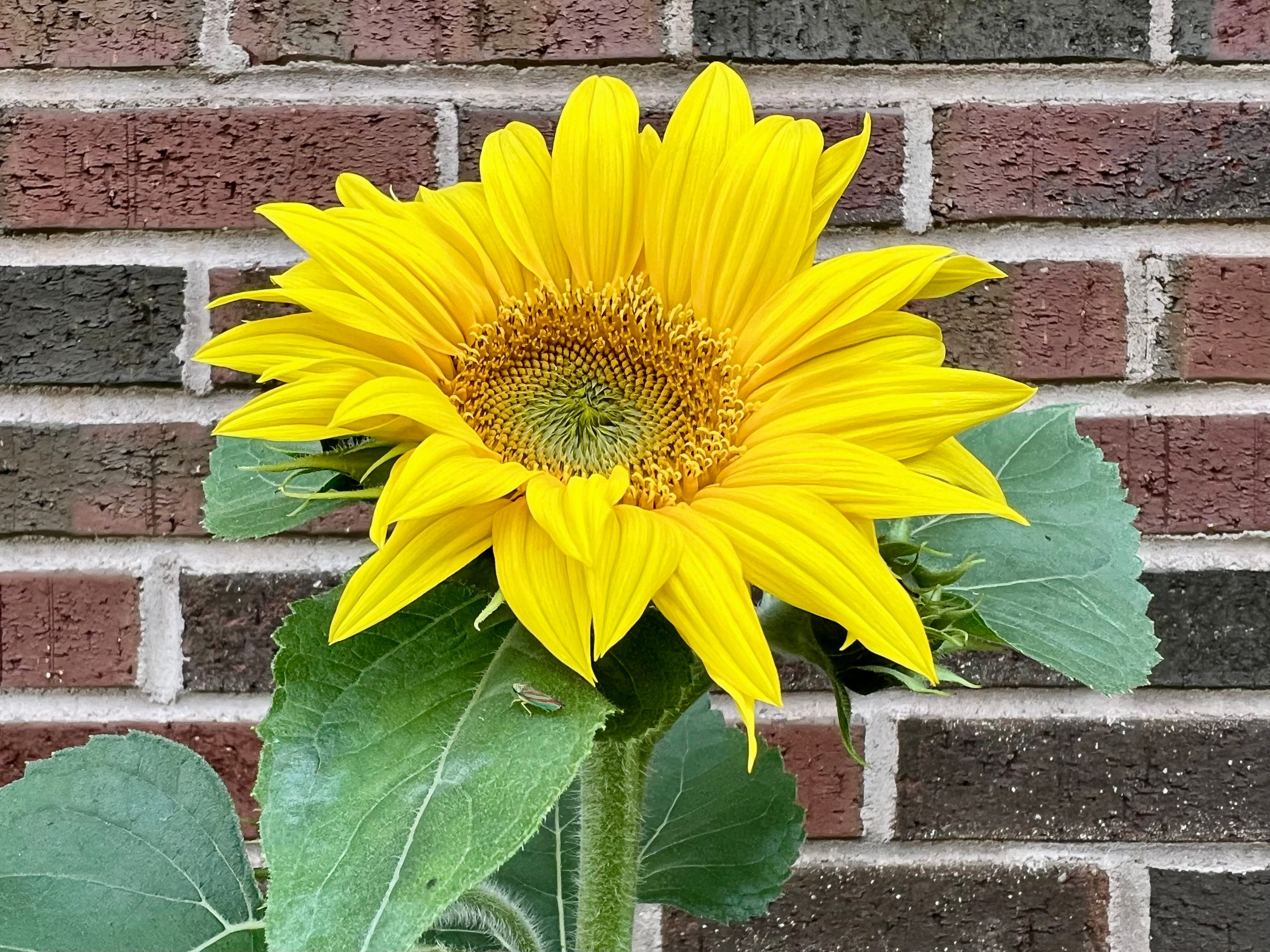
Just off to the left was a for-real sunflower, its thick stalk about my height, with several large buds at the top tucked inside huggy balls of teardrop-shaped petals. I kept an eye on it over the next few days, hoping it would bloom while I was still in town, and sure enough — the topmost flower opened up. I took Dad out in his wheelchair to see it, since it’s not easily visible from within his room. (He was doing okay overall but seemed slightly diminished and less energetic in general, a process that carves new scars into my heart every time I see him.)
Still, how much do I love that even though sunflowers are associated with summer, conditions had apparently aligned for this heat-loving plant to take root and thrive in October, unaided by humans, regardless of the calendar? Who’s to say when it’s time to sprout? Apart from the haywire and irreversible effects of the disaster that is abnormal global warming, of course, who is to dictate proper times of blooming and of lying fallow?
Aging (if we’re lucky) and dying are natural parts of any life cycle.
But how can we live well in the meantime, and take care of other beings and things?
From “Praise Song”:
We have our work: stitching passion
to another’s.
Witness how well we quilt ourselves
into something
useful
from singular
desolation.
While walking in the labyrinth on Sudie’s lovely property, in isolation but with others, I watched as some folks picked up leaves and rocks along the way. I wondered if they were going to keep them or put them back. I myself held one of the unusually jade-colored stones sprinkled along the outer border for part of my journey within the maze, knowing I was going to put it back on my way out.
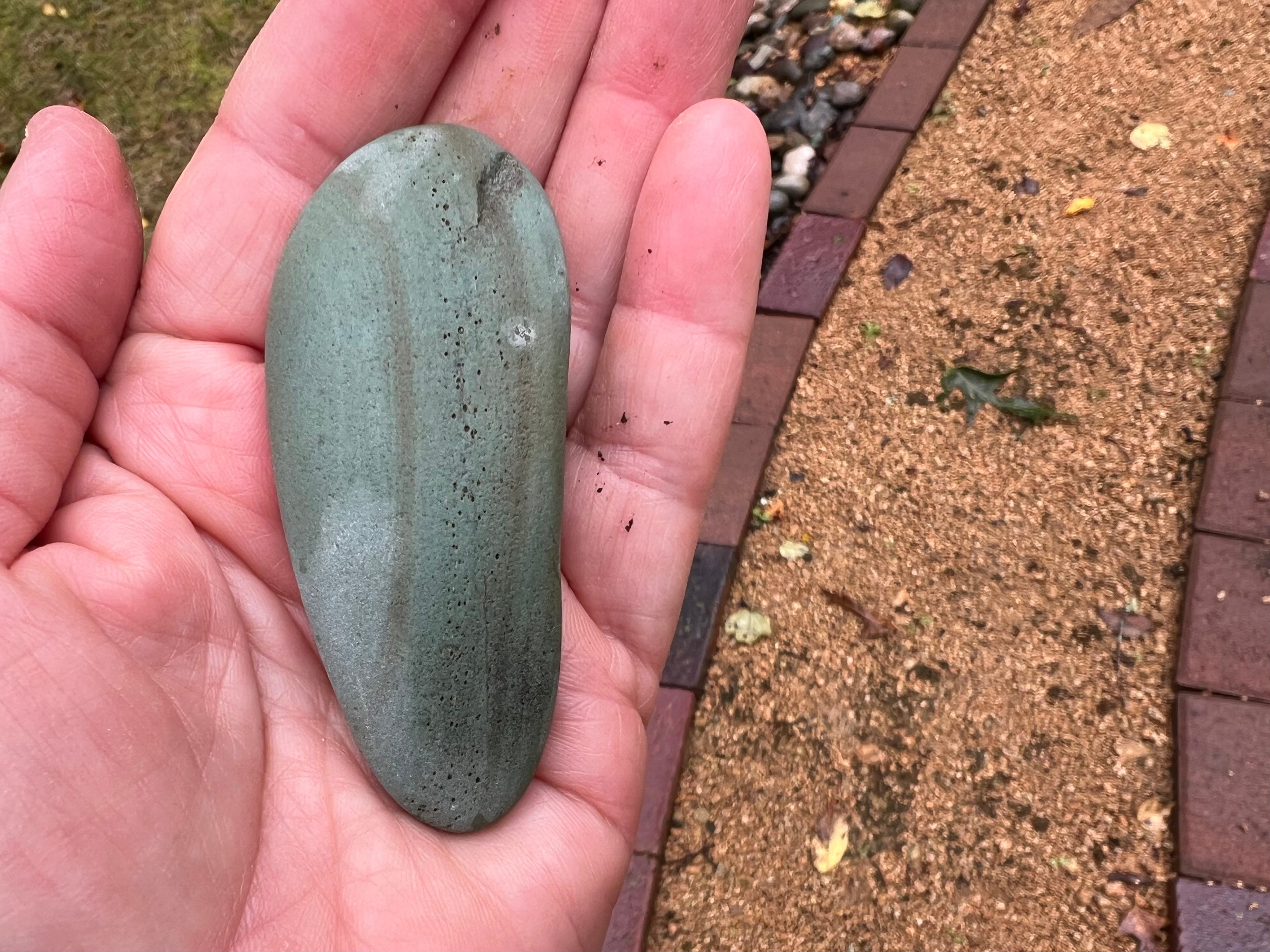
What is ours to carry, and what should we leave for others? What is not for anyone to pick up? What of our stuff — material or otherwise — can we put down — temporarily or forever — and when do we know it’s time to do so?
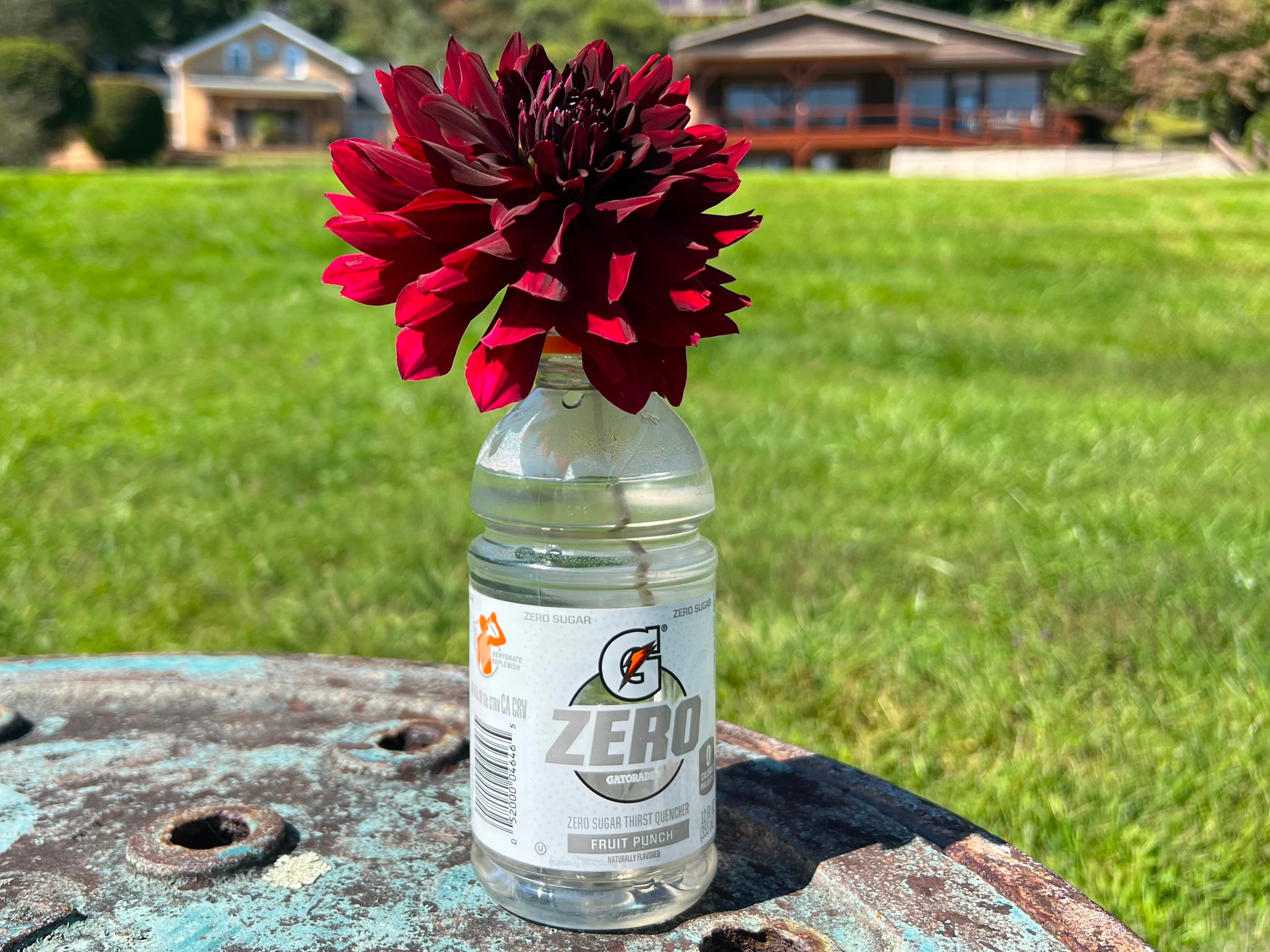
I was tempted to cut the tall nursing home sunflower and take it into my dad’s room, but he declined. I had already cut a smaller one and taken it in, putting it in some water in a plastic orange juice bottle (a la the dahlia from the lake). It was the one among the patch that had sprung up under the feeders — but by then that had all been whacked down by landscapers. I was grateful they’d left the big flower. I wondered why they did. Hardly anyone will see it, but perhaps when it goes (back) to seed, completing its life cycle, birds will enjoy the harvest.
Leslie, this is so good. Thank you so much❤️
What a beautiful phrase ‘to be liberated from my job’…